
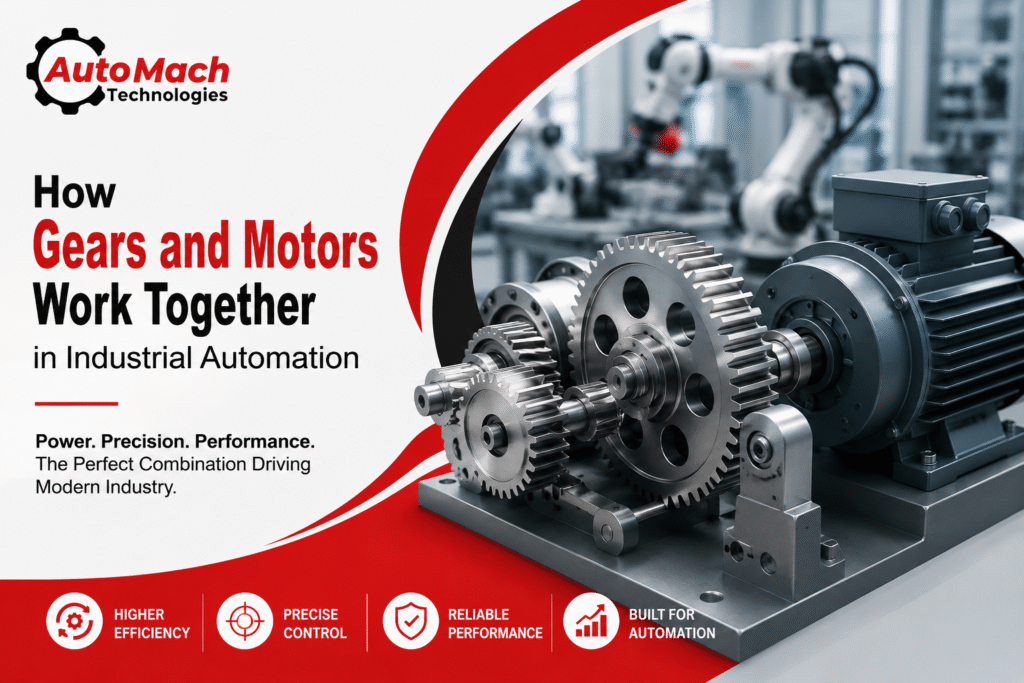
Industrial automation depends on machines that work with speed, accuracy, and consistency. At the heart of these machines are gears and motors. While a motor creates motion, gears control that motion by changing speed, torque, and direction. Together, they help machines perform difficult tasks with high precision.
Whether you operate packaging equipment, CNC machines, conveyors, robotics, or material handling systems, choosing the right gears and motors can improve productivity and reduce downtime.
At Auto-Mach Technologies, we manufacture high-quality precision gears that support industrial automation across different industries.
What Are Gears and Motors?
A motor converts electrical energy into mechanical motion. However, motors alone cannot always deliver the exact speed or torque required by industrial equipment.
Gears solve this problem.
A gear transfers power between rotating parts. It changes the speed, increases torque, or changes the direction of motion.
When gears and motors work together, they create a complete motion control system that delivers better performance.
Simple Example
Think about a conveyor system.
- The motor rotates quickly.
- The gear system reduces the speed.
- Torque increases.
- The conveyor moves heavy products smoothly.
Without gears, the motor would struggle to move heavy loads efficiently.
Why Are Gears and Motors Important in Industrial Automation?
Modern factories need machines that can work for long hours without losing accuracy.
This is why manufacturers combine gears and motors.
Their combination offers several advantages.
1. Higher Torque
Many industrial applications require more force than a motor can provide directly.
Gear systems multiply torque, allowing machines to lift, press, cut, or move heavy materials.
2. Better Speed Control
Different machines require different speeds.
Gear ratios help control motor speed without affecting efficiency.
3. Improved Precision
Robotic arms and CNC machines require accurate positioning.
Precision gears reduce motion errors and improve repeatability.
4. Energy Savings
Motors work more efficiently when paired with properly designed gears.
This reduces energy consumption and operating costs.
5. Longer Equipment Life
Well-designed gear systems reduce stress on motors.
Lower stress means less wear and fewer breakdowns.
How Gears and Motors Work Together
The working process is simple but highly effective.
Step 1: Motor Generates Rotation
The motor produces rotational movement.
Step 2: Gear Receives Power
The gear connects to the motor shaft.
It transfers rotational energy to the driven component.
Step 3: Gear Changes Output
Depending on the gear ratio, it can:
- Increase torque
- Reduce speed
- Increase speed
- Change rotation direction
Step 4: Machine Performs the Task
The controlled movement powers the machine efficiently.
This teamwork between gears and motors helps automation systems deliver consistent results every day.
Common Types of Gears Used with Motors
Spur Gears
Spur gears are the most common type.
They are ideal for:
- Conveyor systems
- Industrial machines
- Material handling equipment
Benefits:
- High efficiency
- Simple design
- Easy maintenance
Helical Gears
Helical gears have angled teeth.
They provide:
- Smooth operation
- Low noise
- Higher load capacity
Applications include:
- Packaging machines
- Printing machines
- Automotive production
Planetary Gears
Planetary gears offer compact design with high torque.
They are widely used in:
- Robotics
- Automation systems
- CNC equipment
- Servo applications
Worm Gears
Worm gears provide high reduction ratios.
They work well in:
- Lifts
- Positioning systems
- Heavy-duty machinery
Industrial Applications of Gears and Motors
Many industries rely on gears and motors every day.
Manufacturing Plants
Used for:
- Assembly lines
- Material transfer
- Packaging systems
Robotics
Robots require accurate movement.
Precision gears help robotic arms achieve exact positioning.
Food Processing
Gear-driven motors operate:
- Mixers
- Fillers
- Conveyor belts
- Packaging equipment
Automotive Industry
Applications include:
- Welding robots
- Painting systems
- Assembly equipment
Pharmaceutical Industry
Automation systems require reliable gear systems for:
- Filling machines
- Labeling machines
- Inspection equipment
Textile Industry
Machines use gears and motors for:
- Fabric handling
- Yarn winding
- Cutting systems
Benefits of Precision Gears
Not every gear delivers the same performance.
Precision gears offer better quality and reliability.
Advantages include:
- High accuracy
- Lower vibration
- Reduced noise
- Longer service life
- Better efficiency
- Consistent motion
- Low maintenance
This is why industries prefer precision gear manufacturers for automation projects.
Factors to Consider When Choosing Gears and Motors
Choosing the right combination improves machine performance.
Consider these factors.
Load Capacity
Understand the weight and force your application requires.
Speed Requirements
Choose the correct gear ratio for the desired output speed.
Torque
Higher torque may require planetary or helical gear systems.
Working Environment
Temperature, dust, moisture, and chemicals affect gear selection.
Accuracy
Automation and robotics require precision gears with tight tolerances.
Maintenance
Select gear systems designed for long service life.
Why Choose Auto-Mach Technologies?
Auto-Mach Technologies has years of experience in precision gear manufacturing.
We design and manufacture high-quality gears that support industrial automation across multiple industries.
Our Strengths
- Precision manufacturing
- Advanced machining technology
- Strict quality inspection
- Custom gear solutions
- Reliable delivery
- Experienced engineering support
- Competitive pricing
Whether you need spur gears, helical gears, planetary gears, or custom gear solutions, our team helps you find the right product for your application.
Frequently Asked Questions
How do gears and motors work together?
A motor creates rotational motion, while gears adjust speed, torque, and direction. Together, gears and motors provide efficient power transmission for industrial machines.
Why are gears important in industrial automation?
Gears improve torque, control speed, increase accuracy, and help machines operate efficiently. They also reduce wear on motors and extend equipment life.
Which gear is best for industrial automation?
The right gear depends on the application. Spur gears work well for simple machines, helical gears provide smooth operation, and planetary gears deliver high torque in compact spaces.
How do precision gears improve machine performance?
Precision gears reduce backlash, minimize vibration, improve positioning accuracy, and increase the overall efficiency of automation systems.
Why choose Auto-Mach Technologies for gears?
Auto-Mach Technologies manufactures high-quality precision gears for industrial automation. Our products offer durability, accuracy, consistent performance, and custom engineering support.
Conclusion
Industrial automation depends on reliable motion control, and gears and motors make that possible. Motors provide the driving force, while gears deliver the right speed, torque, and precision for every application. Together, they help industries improve productivity, reduce downtime, and achieve consistent performance.
If you are looking for dependable precision gear solutions, Auto-Mach Technologies offers expertly engineered products designed for modern automation systems. Our team can help you choose the right gear solution for your specific application and improve the efficiency of your machinery.
