

Synchronous Motor Manufacturer in India for Custom OEM Applications
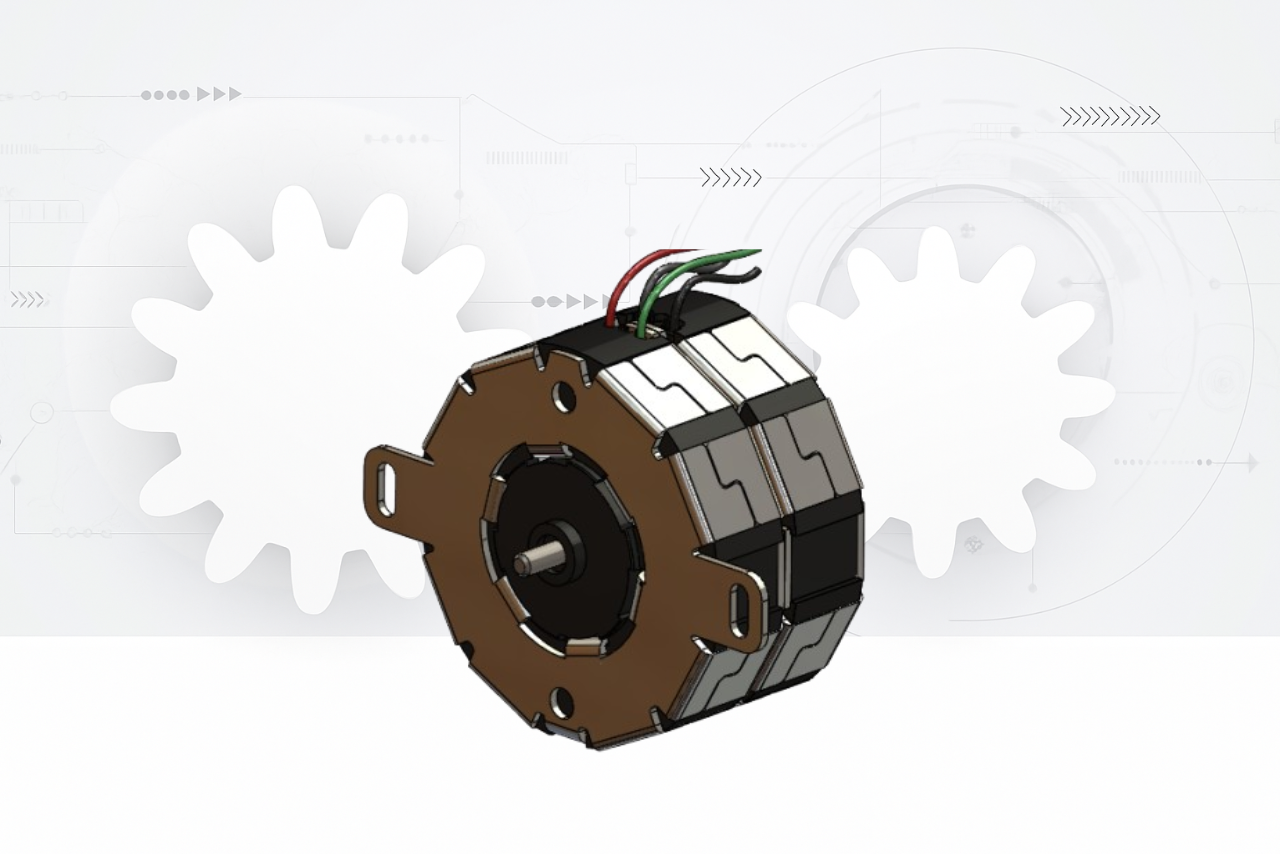
Auto-Mach Technologies is a synchronous motor manufacturer based in Pune, India, building custom AC synchronous motors that hold a fixed speed locked to supply frequency. We've supplied precision motors since 1990 to OEMs across 12 countries. If your machine needs a motor that runs at exact, constant RPM without speed drift, talk to our engineering team about a custom-wound build.
A synchronous motor's rotor turns at the same speed as the rotating magnetic field in the stator, with no slip between the two. That's the whole appeal: precise, repeatable speed control without a feedback loop or a variable-speed drive. Below, we cover how these motors work, where synchronous motor applications show up in real machines, the advantages over other motor types, and how to size the right one for your project.
What Is a Synchronous Motor?
A synchronous motor is an AC motor whose rotor speed matches the frequency of the electrical supply, with zero slip under normal load. Speed is set by a simple formula: synchronous speed (RPM) equals 120 times the supply frequency, divided by the number of poles. Change the frequency or pole count, and you change the speed — but the motor won't drift off that speed on its own, unlike an induction motor. As a synchronous motor manufacturer, we build these units for machines where timing matters more than raw power: clocks, timers, indexing tables, and low-torque positioning drives. Our SM-500-D model is a small synchronous motor, so it fits inside compact housings where an induction motor or stepper motor would be oversized for the job. Request a sample unit and test it against your current motor before you commit to a switch.
How Does a Synchronous Motor Work?
The stator winding creates a rotating magnetic field when AC power is applied. Inside a synchronous motor, the rotor locks onto that field and turns at the exact same rate — this is what "synchronous" means. Because there's no slip, the output speed stays constant even as load changes, within the motor's rated torque limit. A synchronous motor holds a fixed speed with no controller needed, which is why it costs less and runs simpler than a stepper motor for pure constant-speed jobs. If your application needs positioning instead of constant rotation, our stepper motors are usually the better fit — our team can help you pick between the two on a quick call.
What Are the Advantages of a Synchronous Motor?
Synchronous motor advantages come down to speed accuracy, simplicity, and long service life
Constant speed under varying load
The rotor stays locked to supply frequency, so speed doesn't drift as load changes — critical for timing applications.

Simple, low part
count
No feedback sensor or drive electronics are required to hold speed, which lowers your bill of materials and failure points.

Good efficiency at low torque
Small synchronous motors like our SM-500-D run efficiently in continuous-duty, low-torque roles where an induction motor would waste energy.

Compact footprint
Our SM-500-D fits a 51.5 mm diameter, 28.5 mm length envelope — small enough for space-constrained panel and instrument designs.

Long operating life
Fewer moving parts and no brush wear (in most small synchronous designs) mean a longer service interval than brushed DC alternatives.
What Are Common Synchronous Motor Applications?
HVAC
Damper actuators and timer-driven control mechanisms that need steady, repeatable rotation.
Diamond Polishing Machines
Synchronous motors provide steady, controlled rotation for polishing and finishing processes where consistent speed is important.
Automotive
Dashboard clocks, gauge drives, and low-torque indexing mechanisms.
Textile
Slow-speed feed and indexing drives in spinning and finishing equipment.
Hand Tools & Small Appliances
Timer mechanisms and rotating display drives.
Instrumentation & Control Panels
Synchronized readouts, dial drives, and rotating indicators.
Robotics
Light-duty rotational stages where constant speed matters more than high torque.
How Do You Choose the Right Synchronous Motor?
Required torque. Our current SM-500-D covers 2.7 Ncm; higher-torque applications need a custom wind or a different motor type entirely.
Target speed and supply frequency. Since speed is set by the pole count and line frequency, confirm whether you're running on 50 Hz or 60 Hz supply.
Available envelope. The SM-500-D fits a 51.5 mm diameter by 28.5 mm length space — tell us your maximum footprint if that doesn't match.
Shaft and mounting requirements. Panel-mount, flange-mount, or bare-shaft designs all change how the motor integrates into your assembly.
Getting the torque and envelope numbers wrong is the most common reason a stock motor gets rejected during customer testing. That's why we ask for your full spec sheet, or even a rough sketch, before we quote — not just a part number from a competitor's catalog.
Ready to spec your motor?
Get a custom quote for a synchronous motor built to your torque, speed, and mounting requirements — send your spec sheet to our engineering team in Pune and hear back with feasibility and pricing within days.
Frequently Asked Questions
A synchronous motor is used anywhere a machine needs constant, repeatable speed without drift, such as timers, clocks, indexing drives, and control panel dials. Because rotor speed locks to the AC supply frequency, it holds speed steady under changing load without needing a feedback controller.
A synchronous motor's rotor turns at the exact same speed as the magnetic field, with zero slip. An induction motor's rotor always lags slightly behind the field, called slip, which causes small speed variation under load. Synchronous motors suit constant-speed timing jobs; induction motors suit general variable-load industrial drives.
Cost depends on torque rating, winding design, housing size, and order volume, so there's no single fixed price. A standard SM-500-D costs less than a fully custom-wound motor built to a new torque or speed spec. Request a quote with your requirements for an exact price.
Synchronous motor applications appear in HVAC, automotive, textile, hand tools, instrumentation, and robotics, wherever a machine needs fixed-speed rotation. Any application built around timing accuracy rather than raw torque output is a strong fit for a synchronous motor instead of an induction or DC motor.
A synchronous motor advantage over a stepper motor is simplicity: it holds constant speed straight off AC mains with no driver electronics needed. A stepper motor needs a controller and pulse signal to move in steps, which suits positioning tasks better than pure constant-speed rotation.
Yes. We supply sample units of our SM-500-D, or a custom-wound prototype, so you can test torque, speed, and noise before placing a bulk order. This is standard practice for OEM customers qualifying a new motor for their assembly line.
Yes, custom sizes are made to order. If the SM-500-D's 51.5 mm diameter and 28.5 mm length don't fit your envelope, or you need a different torque rating, send us your spec sheet and we'll scope a custom winding and housing design.
We manufacture in Pune, Maharashtra, and export to customers across 12 countries. Whether you need a local pilot batch or a bulk export order, production runs from the same ISO-certified facility with the same quality checks applied to every unit.
Get In Touch